
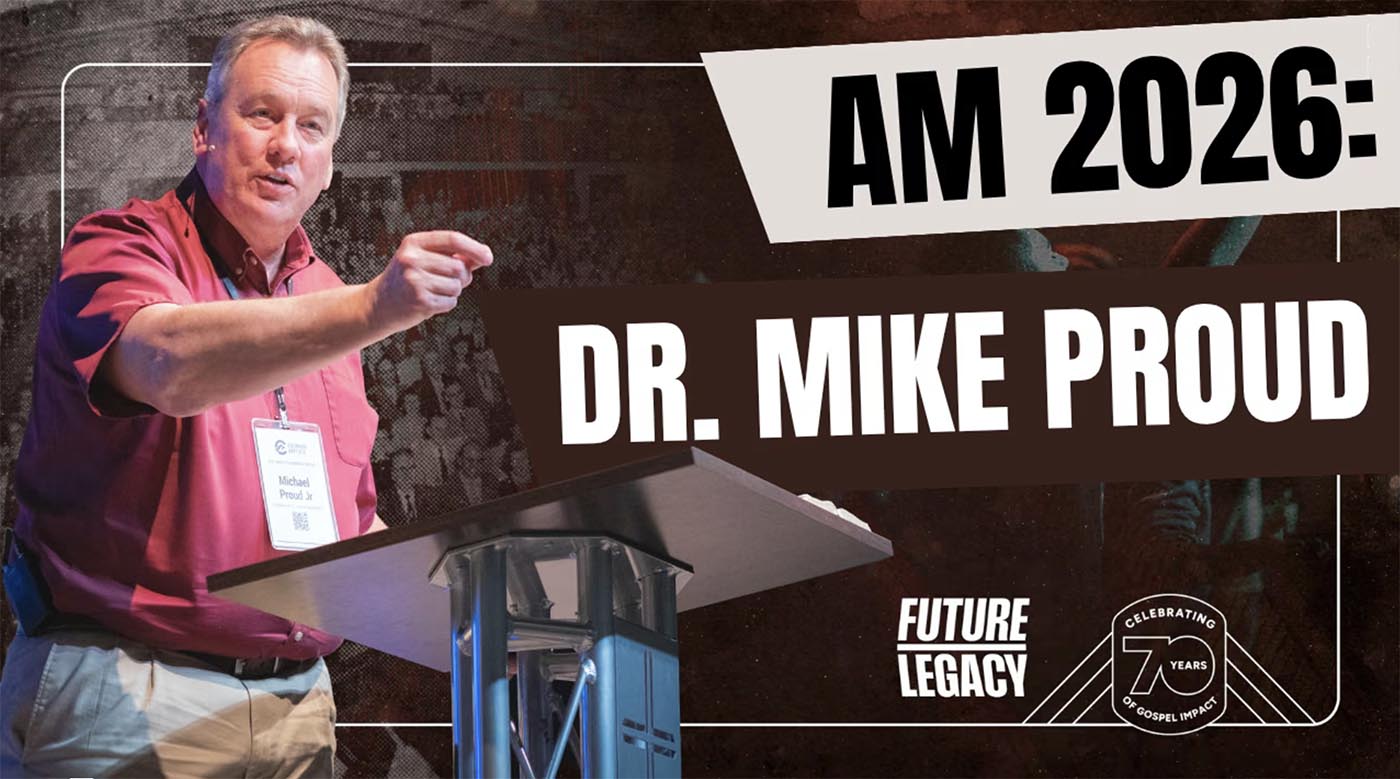
Video Transciption
We’re here 70 years later, and we now stand on the shoulders of those who have served and sacrificed. The work of Colorado Baptists is making a difference. It has an impact, and it has a personal impact. We are here tonight to celebrate building on our past and pressing to the future.
What you’ve heard for the last hour are stories of what God has done, what He’s doing, and specifically of what we are praying and asking God to continue to do here in the state of Colorado. Our partnership with each one of our associations has allowed stories like this to be told, and stories like this are being told in the local associations. But if you don’t live in that local association, you probably have no idea what’s happening. But now you do.
And what have we celebrated tonight? We’ve celebrated that churches have been supported during times of difficulties, that there was someone there on the ground to reach out to.
We’ve celebrated about partnerships between churches which have elevated the spiritual health and gospel focus of local churches. We’ve celebrated that pastors and church leaders were not alone during times of loss or struggle, and that is huge that we’re not in this all by ourselves.
And we celebrate that we’ve seen a statewide emphasis on discipleship that has almost doubled the number of churches that have engaged in the discipleship process in their local church over the last three years.
And what you’ve heard with our regional director reports only scratched the surface of what God has done. We could tell hundreds of more stories than what we have time for today.
But with all these stories, what we know is that we didn’t start in a vacuum.
We’re here 70 years later, and we now stand on the shoulders of those who have served and sacrificed and surrendered for the past 70 years, and that we are here tonight to celebrate building on our past and pressing to the future.
Let’s talk about where we came from.
On January 1st, 1956, the Southern Baptist churches of Colorado, prior to that, were a part of the Arizona Southern Baptist Convention. Southern Baptist work in Colorado began to take place through the foresight of several pioneer-focused pastors, who on January 1st, 1956, 90 churches voted to become part of a new convention called the Colorado Baptist General Convention, which had credentialed members in five and a half states. Those states were Colorado, Wyoming, Montana, North and South Dakota, and then western Nebraska.
W.C. Bryant, who was the first pastor of First Southern Baptist Church of Colorado Springs, which is now Cornerstone, which you’ve heard about, he was the first president of the CBGC.
You see, we stand on shoulders of these churches and church leaders who, through their surrender to God’s leading, are our spiritual ancestors here in Colorado.
And since the time of the Colorado Baptist General Convention’s inception, the gospel began and continues to touch lives of people because there are still people who are willing to sacrifice. Through our partnership in missions, which we know is funded through the
cooperative program, the gospel reach of Southern Baptist stretches within our state, throughout our nation, and to the ends of the Earth.
But what have been the results of this work of the Lord? Not our work, but the work of the Lord over these 70 years. Well, today, we’re a convention that now stands with 373 churches, primarily in the state of Colorado. Over the years, states like the Dakotas and Wyoming and Montana have their own convention that were formerly a part of us, and even though they left us, we continue to grow and see God’s blessing over the years.
When we talk of gospel impact over the last 70 years, we recognize that not every church recorded every baptism. But since January 1, 1956, we have seen recorded through the SBC
archives, 147,551 baptisms here in our Colorado churches.
Now, here’s what I know. We can get lost in numbers, and I don’t want us to do that. I want that to sink in just a little bit. So here’s what I’m going to ask you to do. If you or a child or a grandchild was baptized in a Southern Baptist, Colorado Baptist church, would you stand?
Amen.
And you see, what this represents is that the work of Colorado Baptist is making a difference. It has an impact, and it has a personal impact. Because I was one of those 147,551 people that gave their life and was baptized in a Southern Baptist church. My wife, Sally, was one of those number. Three of four of my children were one of those number.
This is very personal to me. And you see, we’re able to stand, and we’re able to give testimony to God’s greatness because there were people who went before us that sacrificed and were obedient and followed the Lord’s call to make a difference in a lost person’s life, to share the gospel with you or with me.
And those of us who were changed as a result of that were changed because an entire generation of people that went before us said yes to what the Lord called them to do. And there were countless gospel seeds that were sown that represent the harvest, what we just saw.
What else has been happening in Colorado? What else is the result of 70 years of gospel ministry? I reached out to the International Mission Board, and I wanted to ask them how many
IMB missionaries came from Colorado Baptist churches, and here’s what I heard: 432 missionaries went to the field from Colorado Baptist churches. Currently, there are 72 Colorado
Baptist leaders on the mission field reaching people to the ends of the Earth.
What I learned just last week was there are 12 new missionary units, six adults and six children, that Sally and I are going to get to go out and visit, that call Colorado Baptist churches home, that are preparing to go out to the mission field. And we want them to know, as the IMB says a lot, we want them to know that there are churches back home that are holding the other end of the rope. Amen.
Don’t we want to be those people? I started to reach out to the North American Mission Board to get the number of churches that were started as church plants here in Colorado that make up the CBGC, and then I realized all of them at one point were church plants. But we celebrate this, that just as existing churches were investing in new church plants, so they are still investing in new church plants.
So this is our past, and we’ve spent an hour listening to our present. But what about our future?
Our text for this year’s convention is Deuteronomy 6:1-3, and we’ve chosen this text because it has a unique connection between the past and the future. And so to help give context to this passage, we recognize that Deuteronomy served as Moses’ instruction to a new generation of
people that were about to enter the Promised Land.
It was a reminder to those people of what God had done and what He wants to do
through them if they will simply follow Him. In Deuteronomy Chapter 5, Moses recounts the giving of the Ten Commandments so that a new generation will understand that this was the covenant relationship that He wanted His people to enter into. And so as we look at verses one through three of chapter six, there are three insights that I want us to look at just very quickly
that focus on our future. The first one is that we’ll call this insight God’s commands. It was here that Moses looked back on the Ten Commandments, but was preparing for the Shema in chapter six, verse four, and the platform which Moses established here is one of obedience.
And here’s what he says in verse one, “Now this is the commandment, the statutes and judgments which the Lord our God has commanded me to teach you, that you might do them in the land where you are going over to possess it.” The admonition of obedience is foundational to the Christian life, and it is imperative to God’s blessings for his people. And obedience is not just about God’s people doing what they think to be best, it’s about them doing what God directs them to do. It is in this.
Think about these people who are surrendering, who are going into the new land. For a people about going to a new land to live a new way of life, they needed to have anchored in their hearts the instructions of the Lord, and not just hold these anchors as truths in their heart, but applications for their lives. And not just that they were going, the Lord’s command were paramount to their future.
The second insight which Moses imparted, we will call a generational pathway, and this is found in verse two. And it’s in this verse that we hear Moses imparting a legacy of faithfulness based on what he just said in verse one. Listen to Moses’ words in verse two, “That you and your son and your grandson might fear the Lord your God, to keep all his commandments, statutes, and commandments which I command you, all the days of your life, that your days may be prolonged.”
The Lord’s commands spoken in verse one are reiterated here too with a practical aspect of the future. If you want your faith to be passed along to your children and to your children’s children, then you must obey now. We must keep the Lord’s instructions in this new land, or our faith will perish when our time on Earth is gone. Our faith will perish when our time on Earth is gone.
If you want your faith to be passed along to your children or your children’s children, then we have to obey now. We must keep the Lord’s instructions in this new land, or your faith will perish when your time on Earth is through. One day the Lord’s going to call us home. That’s true for everyone in this room. If the Lord tarries, we will all be called home. We will no longer be leading the charge, but the work of the Lord is vital.
There are more people who need to be reached, just as we were reached because of the Lord’s partnership with obedient people who went before us.
Our actions now will influence the generations to come, but the question is, what will that influence be? Will it be an influence of obedience in times of convenience, or will it be an influence of obedience and surrender to God as He directs us and as He guides us for the future? These are the questions that Israel had to answer, and these are the questions that we need to answer as well.
The final insight which we’ll look at is Moses offered here, we’ll call future impact in verse three.
In this verse, Moses said, “O Israel, you should listen and be careful to do it, that it may be well with you, and that you might multiply greatly, just as the Lord, the God of your fathers, has promised you, in a land flowing with milk and honey.”
The future impact flowing from obedience and surrender to the Lord is multiplication and blessing in a new land. I want to think for a minute about what it would’ve been like for a nomadic people who didn’t understand a life of farming. They’d been wanderers for 40 years, now facing the prospect of living in a new land and settling in a new place and living a lifestyle that they were unfamiliar with. And they faced challenges of staying true in a land filled with pagan gods and worship practices that were foreign, and just abominations to God. It must have been somewhat overwhelming for that original generation, save that the Lord was with them.
Now I want you to think about the people who started this convention 70 years ago. They faced some brand-new obstacles. Their focus for ministry application was brand-new. It may have been a bit overwhelming for them as well, save they had the Lord with them.
Now think about where we are today, where you are today. We all stand on the shoulders of those who went before us. And if we want there to be others who have similar testimonies 70 years from now about the faithfulness of those people that lived 70 years ago, then we’ve got to do the same thing that our ancestors did. We need to follow the Lord’s commands. We need to follow a generational pathway, and we need to impact the future.
So what does the future look like? Right now in Colorado, we have just a little over six million people in the state. On average, the estimate is 90% of that population across the state is unchurched or lost, meaning about 5.4 million people need to know Jesus. There are an estimated 3,800 evangelical churches, according to AI, in the state of Colorado, and it’s pretty loosely defined.
But that means if those 3,800 evangelical churches were to reach 1,421 people each, then we could evangelize the state. But with the average evangelical church under 100, we’re not doing it.
So what do we need to do? What does the future look like?
We need to plant more churches. We need to plant more churches. On November 5th, you’re going to see a slide that’s going to come up here. On November 5th, there’s going to be a NAMB One Day Conference that’s going to be held at Riverside, and it’s going to be a conference that’s discussing what it’s going to look like to reach the lost of Colorado. And if you have your phone out, I’d encourage you to scan that QR code and register for that event. It’s going to be a great event.
We also need to see more believers discipled who will in turn reach their friends with the gospel. In the fall of 2023, our leadership team got together and we talked about the need for leaders in the state of Colorado. You heard about small churches. How are small churches going to reach out and bring new pastors when they no longer have parsonages because years ago they sold them to pay the bills, but now they don’t have resources to do that. Their communities and the industry in their communities has shrunk, and now what are they going to do?
We need to raise up Colorado leaders that can go over, as we’ve heard testimonies about, and lead those churches. We identified 60. And again, we didn’t identify everybody. We didn’t know everyone, but 60 churches were identified that had a clear discipling pathway in their church. And so we prayed about that. We prayed, if we’re going to see leaders, we got to see discipleship in churches. And through the leadership of our regional directors, they began to work through each association, talk with pastors, and help pastors to define that process. And what we’ve come to, estimated at the end of 2026, three years later, is that we’ve estimated or identified 120 of those churches. Now, our goal was 185, half of our churches to have a discipling process by the end of 2026. We’re not going to make that, but we’re celebrating that we are almost twice as many as we had before. Amen?
It’s because they were faithful to do the work, to walk with pastors and pray with pastors and assist pastors. We need to pray that these discipled believers surrender to congregational leadership so we can see more leaders in Colorado lead Colorado churches. That’s what we need to do.
And while we’ve not completed the race, we are seeing progress made, and I want us to celebrate that progress. I want us to celebrate almost 3,600 missionary units through the International Mission Board that are supported because you give to the cooperative program. The convention, the Colorado Baptist General Convention, does nothing. You do it. It’s your churches You give. And what I love to tell churches, regardless of their size, I love to say to them, “Look, every church that gives to the cooperative program has an equal part.” We don’t gradate those things. We don’t say, “You have a more part than you have.” Everybody has an equal part that partners in sending those missionaries overseas to reach people that we’ll never reach.
But there are people who are going, like Lottie Moon. They want to sacrifice everything, and they want to go and see people reached for Christ.
We’re making advances in seeing new churches planted across North America, just under 800 new churches planted each year through the North American Mission Board. You directly send– Again, the convention does nothing. You do this. When you give your money to the Colorado Baptist General Convention, we’re simply stewards of your money. And I want you to hear this.
You give $53,800 every year to the Rocky Mountain Campus at Gateway Seminary. Some of that money that comes through the Colorado Mission Offering goes to scholarships. And you heard Josh come up here, Dr. Hutchins, talk about scholarships to students so that students have a solid theological education for ministry. This semester alone, I received eight letters from students that received scholarships that were thanking not me, thanking you for the work and the partnership and what you did to make it possible that they could go to seminary.
And because of your commitment to the cooperative program, those seven regional directors that you just heard their testimonies about are supporting and caring for churches and pastors in their areas of ministry need.
And then Ponderosa, you didn’t get to see a testimony or a video on this. But at Ponderosa,
the bell at the bottom of the dining hall has been rung 123 times this year. Now, I don’t want to steal Andrew’s thunder, but that comes because of great leadership, Andrew Clark and his team at Ponderosa.
But it also comes because of your partnership, because that camp was sold in 2021, and then that sale fell through, and God restored it, and it’s reaching people for Christ. Giving is great. Giving is needed, but giving is not everything. We’ve got to go as well. You saw illustrations in those videos and testimonies tonight about what going looks like. So what does going look like?
Like the Mile High Baptist Association, where we learned that international churches are impacting an area in which is vastly diverse in culture and only growing more diverse. 40% of the churches in Mile High speak a language other than English in their primary service of worship. You heard the testimony of the Continental Divide, where six Spanish-speaking pastors worked together to start another Spanish-speaking congregation in Manassa.
You heard testimonies in Pikes Peak Baptist Association, where churches are boldly making changes needed to be more effective in their communities in reaching the lost for Christ. And change is hard, folks. You know that. How many Baptists does it take to change a light bulb?
Change? That’s the question. Change is hard. But they’re asking the hard questions, and they’re making the hard decisions so they can be more effective in reaching people for Christ. Or the Royal Gorge Baptist Association, where people are waking up. They’re awakening their people to embrace the conviction.
And I love the way Nate said this: “We cannot do nothing. We must do something.” They must do something. Or in the Mesa Verde Baptist Association, where you saw that a natural disaster was simply a platform that was used to reach hurting people with the gospel.
And in Grand Valley Association, where English-speaking churches are supporting Spanish-speaking churches to more effectively reach their communities. It will take all of us going to realize the call that God has given to all of us to surrender to his instructions and see the gospel spread into the next 70 years.
But we must be obedient to his commands. We must see a generational pathway established
so that we can together impact the future for God’s glory. And while we say this a lot at Colorado Baptist Convention, sometimes I think we feel like it’s overused. Folks, we really are better together.
Amen.